What is Concurrency?
Overlapping execution time.
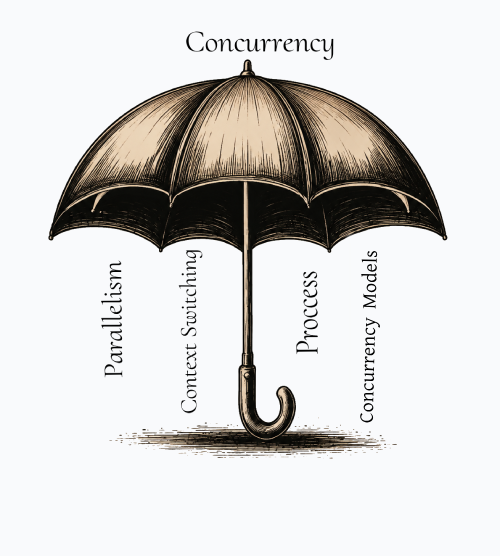
Concurrency is an umbral term in computer science, that we have no single formal standardized definition( like Algorithm, Service …).
Concurrency refers to the ability of a system to execute multiple tasks through simultaneous execution or time-sharing (context switching), sharing resources and managing interactions.
Concurrent programming, in which different parts of a program execute independently, and parallel programming, in which different parts of a program execute at the same time,
Rob Pike, co-creator of the Go programming language:
Concurrency is about dealing with lots of things at once. Parallelism is about doing lots of things at once.
Are dealing as same as doing? short answer no :)
Imagine we have a single core (single threaded) CPU, therefore we are able to execute just one instruction at a time. However, we have three tasks of playing music, messaging on Slack, downloading a file.
We have two options available for execution:
- Sequential execution, wait one finishes and then start the second (this is not what happens on a real OS)
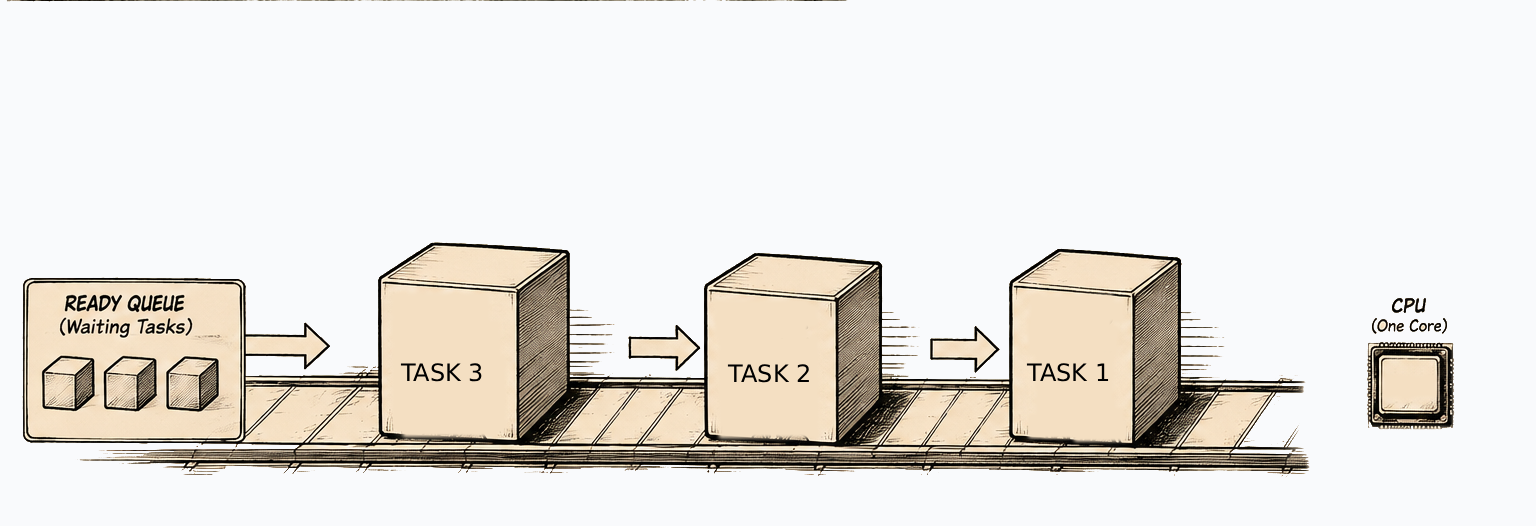
- Switch between execution of tasks, a scheduler gives each task a tiny slice of CPU time(milliseconds), and forcibly interrupts it and switch to the next task.
- Your keystrokes in Slack get their own tiny slice to be processed.
- The music player’s audio buffer gets its own tiny slice to keep decoding/streaming samples.
- The download gets its own tiny slice to receive network packets.
Intuitively, it feels like the song is playing and stops, the other tasks turn, and a chunk of song is played …, However, when we do the context switching so many times in a second. Every task is being interrupted and resumed extremely rapidly, not blocked-until-you’re-done.
Are they concurrent?
yes, based on this assumption:
Two tasks are concurrent if their execution intervals overlap in time, task A starts before task B finishes. Just that, overlapping time periods.
The definition says nothing about whether a single core is switching between them or whether they’re on separate cores. It only cares about the interval relationship.
What happens if we did not need to interrupt task while execution?
If we had enough execution units(cores, threads) each of them gets a task, therefore we are executing the task without an interruption. It is called parallelism.
Parallel computing is a type of computation in which many calculations or processes are carried out simultaneously.
Core 1 (Task A): |—————–|
Core 2 (Task B): |—————–|
Aren’t there execution times overlap?
Yes there are. That is the maximal possible overlap, so by the definition, it is a form of concurrency.
Therefore, we can claim:
-
All parallel execution is concurrent
-
Not all concurrent execution is parallel (the single-core music/Slack/download example proves this. Overlap exists (interval-wise))
-
Parallelism ⊂ Concurrency
Concurrency model in Node.js:
In node.js Concurrency is achieved by non-blocking I/O: when you call fs.readFile or make an HTTP request, Node hands the work off to the OS/libuv thread pool (or OS async APIs) and immediately moves to the next task in the queue. When the I/O completes, a callback is queued back onto the event loop.
What is async/await?
Async/await doesn’t change any of the above.it’s syntax sugar over the concurrency model, specifically designed to make non-blocking, callback-based concurrency read like sequential code.
Race condition: shared/mutable/state
A race condition happens when the correctness of a program depends on the timing or ordering of operations that access shared, mutable state and that ordering isn’t guaranteed.
When exactly does it occur?
A race condition requires three ingredients simultaneously:
1 - Shared state: two or more tasks access the same variable, object, file, DB row, etc.
2 - At least one write: if everyone’s only reading, there’s nothing to race over.
3 - No enforced ordering: nothing guarantees task A’s read-modify-write completes atomically before task B’s does.
Concurrency is the necessary condition, not the cause.